My Table Book on Happiness
add_circle الإيجابيات
- Scientifically grounded and wisely presented guide to inner honesty and harmony
- Helps understand how personal happiness can be built from individual elements
- Practical recommendations for achieving happiness
- Accessible language and clear structure
- A scientifically grounded and wisely presented guide to inner honesty and harmony
remove_circle السلبيات
- Some people may find the book's structure too fragmented
- The book may not provide ready-made recipes for happiness
- The book's focus on individual elements may not appeal to everyone
- The book's language and structure may not be engaging for some readers
- The book's emphasis on effort and hard work may be challenging for some people
المعرض





Editor's Summary
This book by Mikhail Litvak is a scientifically grounded and wisely presented guide to inner honesty and harmony. It helps understand how personal happiness can be built from individual elements and how not to destroy the important for the sake of fleeting emotions.
My Table Book on Happiness
I believe in science, and psychology is a science. It's a specific discipline that requires specialized knowledge and practice, making it understandable to everyone. Mikhail Litvak, rest his soul, was able to explain this complex science in simple, accessible language. I'm grateful for that, as he left behind books that help many people today see and understand the patterns of human life without romanticization or drama, but also without oversimplification. Life is not simple.
I don't believe in people whose lives are 100% successful in all areas. I've never met anyone like that. Statistically, it's almost impossible: there are too many directions in life and too many factors to keep everything at 100% - from health and great teeth and hair to trusting relationships with your sister-in-law, and all that with a seven-digit annual salary. I don't understand people who say, 'I'm doing great!' I'm not doing great in everything, and I'm not ashamed of it. Before I read this book, I often complained that I was doing poorly in this and that, and also in the fifth and tenth areas, and that I was fat and ugly. As soon as I read and thought about it, I realized that it's normal.
About the Book
If you want to be happy, this is one of Mikhail Litvak's most famous works. Depending on the edition, the book is available in different formats - from classic print to electronic and audiobooks. I always read the book in electronic format, so please don't judge me for the screenshots:
Usually, it was published by major Russian publishers like 'Exmo,' AST, or 'Peter.' The book's volume varies from edition to edition - it's usually around 300 pages of live and engaging text.
The Book's Structure
Litvak structures the book as reflections, observations, and practical recommendations. Some people don't like it, and I understand that. However, he maintains his recognizable style: combining observations, personal examples, and logic with precise formulations.
Who the Book is For
The book is addressed to 'those who have lost hope and dropped their hands':
My Reading Experience
The main idea of the book is that happiness should be based on four pillars that work together in harmony: I - Me - Them - Effort:
I - this is the inner core, self-respect, the ability to understand oneself, one's desires, and boundaries.Me - this is our close ones, the relationships where there is trust, reciprocity, and care.Them - this is the surrounding society, acquaintances, and strangers, social roles through which we actually exist.Effort - this is the activity that gives our life meaning, forms our competence, and our support in reality.
My Theory of Happiness
This 'I-Me-Them-Effort' model by Litvak is close to me. Long before I met the book, I formulated my own theory of happiness - the 'pie theory' (C) by user mobydick.
In life, each person has many areas. And, as I said earlier, none of them will be equally complete at any given moment. We can't (yet) be in two places at once. You can? I can't. It's logical that one life segment often becomes more prominent than others because another is temporarily reduced. This is normal. This is life.
Work
A grown-up person spends conditional 8 hours at work on weekdays. If you love your job, it's not a torture and not a wait for evening or weekends - it's a satisfying part of life that brings income. Even if the income is low, see below in the 'I' and 'Me' sections: two low incomes + reasonable spending + advice + love - this is already a worthy life.
I
But if there are complexities in the professional sphere, I rely on other segments - on I, on Me. I found myself in a situation on the verge of a professional failure. And I had myself - I exercised, walked in the forest, did wraps, took care of myself, and strengthened myself. Here's the key phrase that tells us what to do in terms of our 'I':
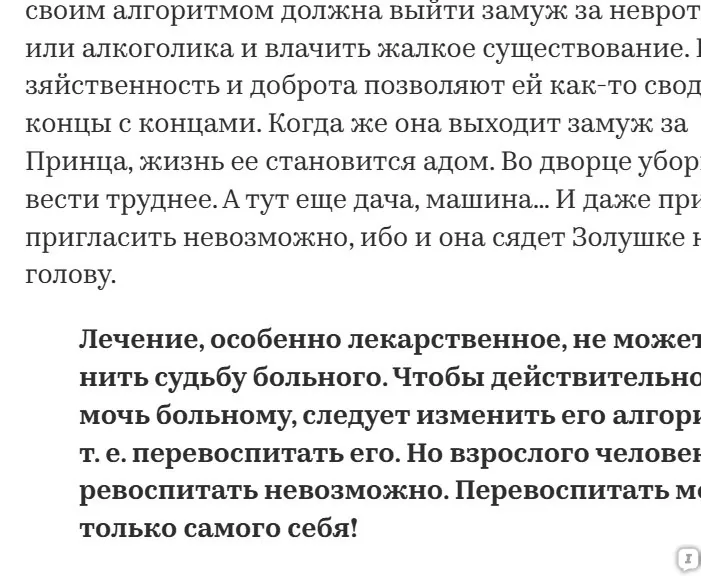
I told myself: what can I do with all this now? Nothing, I'm alone. Better go, take care of myself, clean the house, cook something, and then we'll see. After some time, it usually becomes clearer.
Me
After relieving myself, I drew strength from communication with loved ones. It's essential not to do the opposite. And it always helped me restore my inner balance, gather strength. And now, when I remember the crazy crises at work, I'm even surprised how many people experienced and pushed themselves into an extraordinary, brutal corner. Alone.
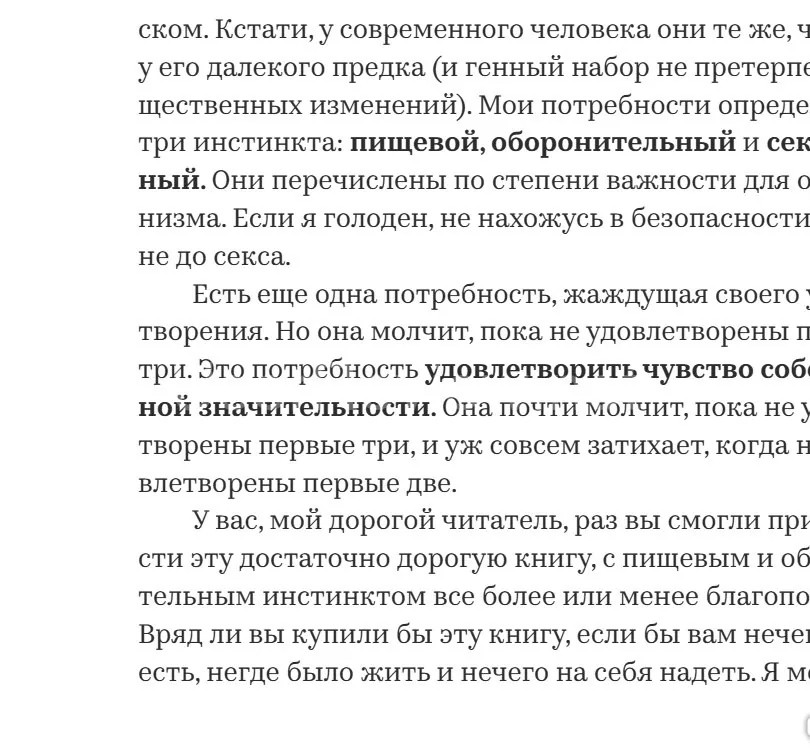
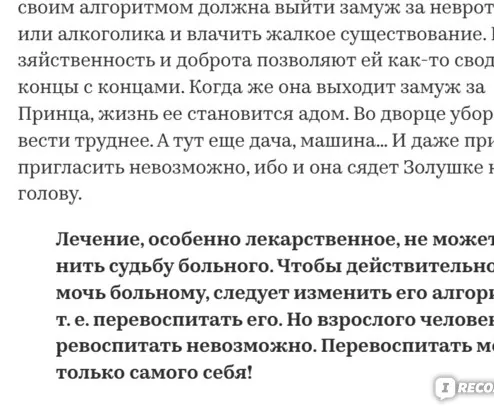
In the book, there's also something about sex in the 'I-Me' section. Somehow:
Why is sex equated with a promotion? Okay, let's move on...
Them
I respect people. My attitude towards 'them' - towards strangers, towards those who cross my path randomly and without ill intent - has always been correct. No, I won't let anyone violate my boundaries. But I won't 'lose my temper' at a stranger: unleashing anger on someone won't make me happier, I've always known that, and I've never tried to do it. I know that it would destroy 'me.'
Harmony
That's why I value Litvak's work - for its scientific basis and wise presentation. No, Labykovsky is also interesting, but he's too fragmented for me, too chaotic.
This book by Litvak doesn't give ready-made recipes for happiness, unlike Labykovsky. However, it helps understand how personal happiness can be built from individual elements and how not to destroy the important for the sake of fleeting emotions.
***
For me, this is not just popular psychology - it's a scientifically grounded and wisely presented guide to inner honesty and harmony.
Featured FAQ
What is the main idea of the book?The main idea of the book is that happiness should be based on four pillars that work together in harmony: I - Me - Them - Effort.
Who is the book addressed to?The book is addressed to 'those who have lost hope and dropped their hands'.
What is the 'I-Me-Them-Effort' model?The 'I-Me-Them-Effort' model is a framework for understanding how personal happiness can be built from individual elements.
What is the 'pie theory'?The 'pie theory' is a personal theory of happiness formulated by the author.
What is the book's structure?The book is structured as reflections, observations, and practical recommendations.